Khashuri
Crossroads town beneath Surami's walls
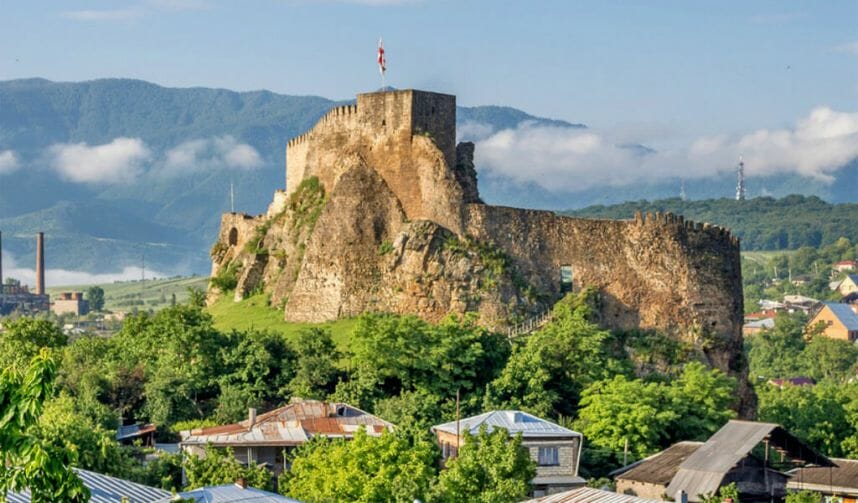
You come to Khashuri as travelers always have: it's the hinge of central Georgia, where roads to Tbilisi, the Black Sea and Borjomi all meet. Expect fortress ruins on the hill, plane-tree shade, hearty Imeretian-Kartlian cooking, and an unhurried, genuinely local rhythm.
How long to stay?
A day is enough to climb to Surami Fortress for the valley view, wander the town center past the clock tower and St. Nicholas basilica, then settle into a long khachapuri-and-wine lunch at a Georgian restaurant downtown.
Workaday and warm, not touristy. This is a real Georgian transit town: families on benches, marshrutka horns, smoke from grills. Hospitality is reflexive here, and a refused toast is the only real faux pas.
Most visitors stay near the central square and the train station, walkable to cafes and restaurants. For quiet, look toward Surami, the leafy resort suburb just north, long beloved for its clean air and pine slopes.
Buy Surami's famous nazuki, the sweet spiced bread sold hot from roadside stalls along the old highway. Vendors press loaves through car windows; it's a Georgian road-trip ritual you shouldn't skip.
Late spring through early autumn (May to October) is ideal: warm days, green hills, and lake weather. Summer draws Georgians to Surami for the cool mountain air. Winters are cold, grey and quiet.
Khashuri sits on the main Tbilisi-Batumi line, roughly two hours from Tbilisi by frequent marshrutka or train. Driving the central highway is easiest; it's a natural stop en route to Borjomi or the coast.
Currency is the Georgian lari; Georgian (with its own alphabet) is spoken, Russian often understood, English rarely. Carry cash for stalls and small cafes. Tipping is uncommon but appreciated. Toasts are taken seriously.