How to Plan a Solo Trip (2026 Guide)
From picking a city to walking your optimized route on day one. No spreadsheets. No overthinking.
You do not need a travel buddy to have an incredible trip. Some of the best trips happen when you stop waiting for everyone's schedule to align and just go. Solo travel is not about being alone. It is about having complete freedom over what you do, when you do it, and how long you spend doing it.
But planning a solo trip can feel overwhelming, especially if it is your first one. Where do you even start? How do you build an itinerary without spending days on research? How do you stay safe? What if you get lonely?
This guide covers everything. From picking a destination to walking your optimized route on day one. Whether it is your first solo trip or your tenth, you will find something useful here.
Why Solo Travel Is Worth It
There is a reason solo travel keeps growing year after year. It is not a trend. It is people realizing that waiting for the perfect group trip to come together means waiting forever.
Here is what changes when you travel alone:
- You move at your own pace. Want to spend three hours at a museum? Do it. Want to skip it entirely and find a cafe? Also fine. Nobody is compromising.
- You actually talk to people. Solo travelers meet more locals and other travelers than groups do. When you are alone, you are approachable. When you are in a group of five, you are a closed circle.
- You build real confidence. Navigating a foreign city alone, figuring out transport, ordering food in a language you do not speak. These small wins stack up fast.
- You discover what you actually like. Without group dynamics influencing your choices, you find out what kind of traveler you really are.
The biggest regret solo travelers have is not doing it sooner. The second biggest is not having a plan and wasting half the trip figuring out what to do each morning.
Step 1: Pick a Destination
This is where most people get stuck. They open Google, search "best solo travel destinations," find 47 listicles with 200 different cities, and close the tab feeling more confused than before.
Here is a simpler framework. Ask yourself three questions:
Walkable?
Solo travel is better in cities you can explore on foot. Less time figuring out transit means more time discovering.
Safe?
Check travel advisories. Stick to cities with good infrastructure and a reputation for welcoming solo travelers.
Interesting to you?
Not to a blog. Not to Instagram. To you. Pick the city you keep thinking about, not the one everyone says you should visit.
If this is your first solo trip, start with a city that is easy to navigate, has a lot of English speakers, and is known for being safe. Places like Lisbon, Tokyo, Barcelona, Amsterdam, or Prague are popular first solo trips for a reason.
Do not overthink it. You can always go somewhere else next time. The point is to go.
Step 2: Set Your Dates and Budget
Solo travel has a massive advantage here: you only need to check one calendar. No back-and-forth with five people trying to find a weekend that works. Pick the dates that work for you and book.
For a first solo trip, 3 to 5 days is the sweet spot. Long enough to see a city properly. Short enough that it does not feel daunting if you have never traveled alone before.
For budget, a rough breakdown for a European city:
| Category | Budget | Mid-Range |
|---|---|---|
| Accommodation | $25-50/night | $80-150/night |
| Food | $20-30/day | $40-70/day |
| Attractions | $10-20/day | $20-40/day |
| Transport | $5-10/day | $10-20/day |
The beauty of solo travel is that every dollar saved or spent is your choice. No splitting bills with someone who ordered three cocktails when you had water.
Step 3: Book Flights and Accommodation
Book flights first. Use Google Flights or Skyscanner, set flexible dates if you can, and pick the cheapest option that does not involve a 12-hour layover.
For accommodation as a solo traveler, you have options that groups do not:
- Hostels. Not just for 18-year-olds with backpacks. Many modern hostels have private rooms, coworking spaces, and social events. Great for meeting other solo travelers.
- Small hotels or guesthouses. More privacy than a hostel, cheaper than a big hotel. Look for ones in walkable neighborhoods close to the center.
- Airbnb. Good for longer stays or if you want a kitchen. Pick something central so you are not spending half your trip on transport.
Location matters more when you are solo. You want to be close to the action so you can walk out the door and start exploring without a 30-minute commute.
Step 4: Build Your Itinerary
This is the part where most solo travelers either overplan or underplan. Overplanners create a spreadsheet with 15 things per day and burn out by lunch. Underplanners wing it and end up wandering aimlessly, googling "things to do near me" every two hours.
The sweet spot is having a structure that tells you where to go and in what order, but with enough flexibility to go off-script when something catches your eye.
This is where SwipeSights works especially well for solo travelers. Here is how:
Create a trip.
Pick your city and dates. 30 seconds.
Swipe through attractions.
You will see 60 to 100 real attractions with photos, ratings, descriptions, and visit durations. Swipe right on places that interest you, left on ones that do not. Super-like the must-sees.
Get your itinerary.
The app builds a day-by-day walking route from the places you picked. Nearby spots on the same day. Opening hours checked. Meal breaks included. Walking times between every stop.
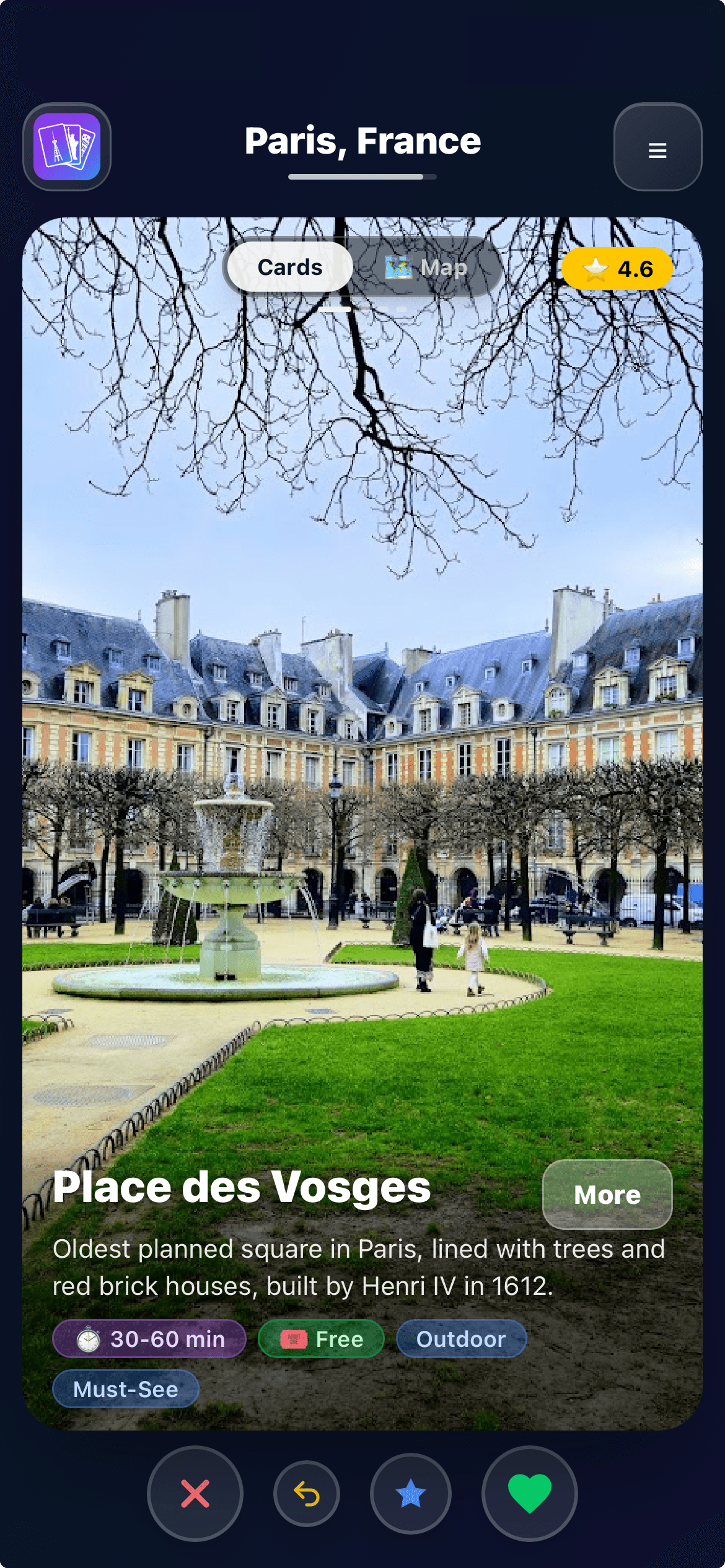
Swipe through real attractions with photos, ratings, and descriptions.
The whole process takes about 10 minutes. You go from "I have no idea what to do in this city" to a complete day-by-day plan with a walkable route, timed stops, and restaurant suggestions.
For solo travelers this is particularly useful because:
- No research rabbit hole. You do not need to spend hours reading blog posts and comparing TripAdvisor reviews. The attractions are already curated with real data.
- The route makes sense. Nearby attractions land on the same day. No zigzagging across the city. You walk a logical path and save hours of wasted time.
- You discover places you would never find. Swiping through 60+ attractions exposes you to hidden gems that would never show up in a "top 10 things to do" list.
- Flexibility built in. The itinerary is a guide, not a contract. See something interesting along the way? Stop. Skip something? The rest of the day still works.
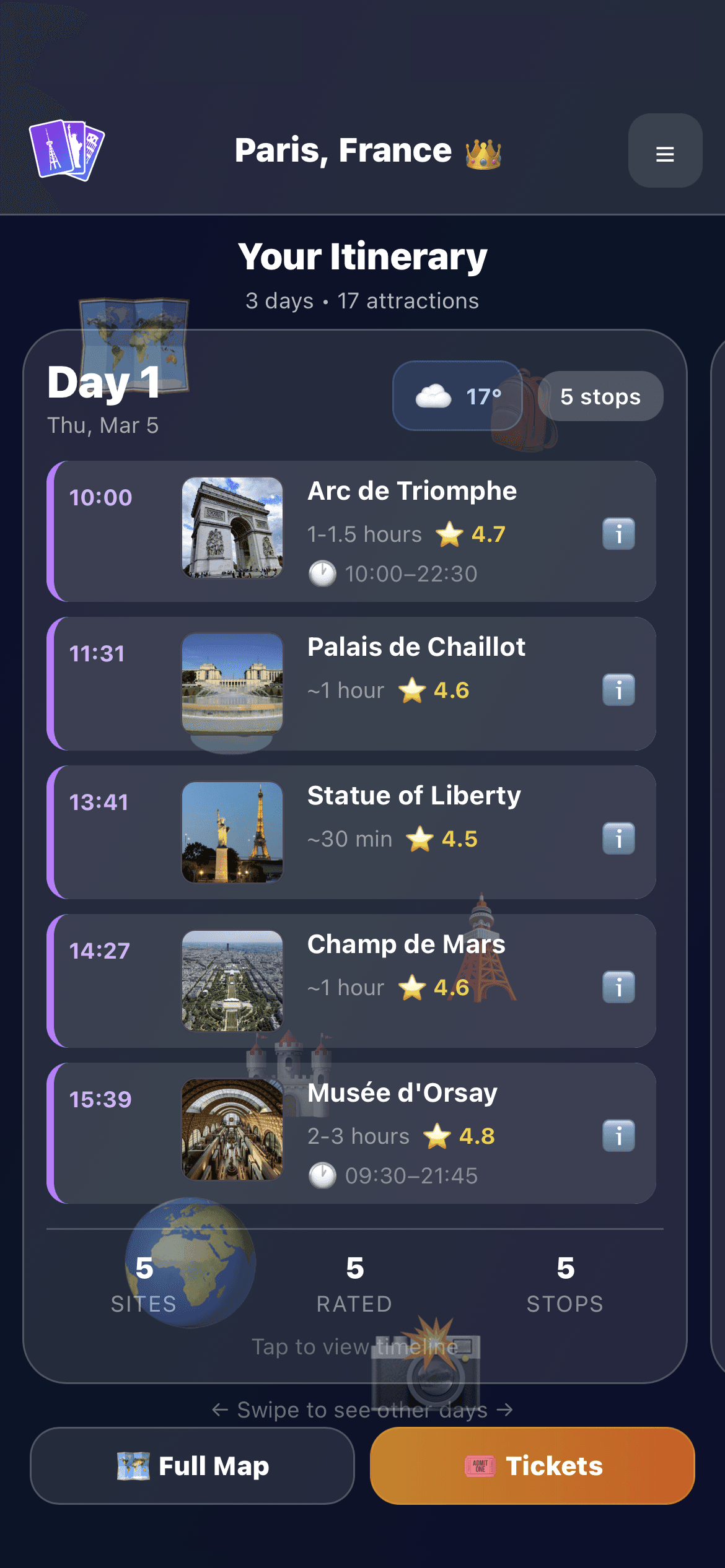
A complete day-by-day itinerary with walking times between every stop.
Step 5: Handle the Logistics
With your flights, accommodation, and itinerary sorted, there are a few practical things to take care of before you leave:
- Travel insurance. Non-negotiable for solo travelers. If something goes wrong, you do not have a travel partner to help. Companies like SafetyWing or World Nomads offer affordable plans for solo trips.
- Phone and data. Get an eSIM or local SIM card so you have data for maps, translation, and communication. Airalo and Holafly are popular options.
- Copies of documents. Photo your passport, ID, insurance card, and booking confirmations. Store them in your email and in a cloud folder. If you lose your phone or wallet, you have backups.
- Bank notification. Tell your bank you are traveling so they do not freeze your card. Also check ATM fees and consider getting a card with no foreign transaction fees.
- Visa check. Do not assume. Check visa requirements for your specific passport and destination. Some countries require visas even for short tourist visits.
None of this takes long. An hour of logistics now saves you from headaches on the ground.
Step 6: Pack Smart
Solo travel means you carry everything yourself. No splitting gear between two suitcases. No asking someone to hold your bag while you run to the bathroom. Pack light or regret it.
Solo Trip Packing Checklist
Essentials
☐ Passport / ID
☐ Phone + charger + power bank
☐ Debit/credit card (no foreign fees)
☐ Small daypack for daily walks
☐ Comfortable walking shoes
☐ Travel insurance docs
Nice to Have
☐ Portable lock (for hostels)
☐ Reusable water bottle
☐ Universal adapter
☐ Earbuds / headphones
☐ Light rain jacket
☐ Small first aid kit
The golden rule: if you are debating whether to bring something, leave it. You can buy almost anything at your destination and you will be glad you have less to carry.
Solo Travel Safety Tips
Solo travel is generally safe, especially in the cities most solo travelers visit. But being alone means being more aware. Here are practical tips that actually matter:
Share Your Itinerary
Send your day-by-day plan to a friend or family member. SwipeSights lets you export your itinerary as an image or PDF. Share it so someone always knows your rough location.
Stay Connected
Keep your phone charged and have data. A working phone is your map, translator, emergency contact, and ride home all in one.
Trust Your Instincts
If a situation feels off, leave. You do not owe anyone politeness at the expense of your safety. This applies to taxis, bars, tours, and any interaction that makes you uncomfortable.
Know Your Route Home
Before you go out at night, know how to get back to your accommodation. Save the address in your phone. Screenshot the map. Have a backup plan if your phone dies.
Most solo travelers report feeling safer than they expected. The key is preparation, not paranoia. Have a plan, stay aware, and you will be fine.
Best Solo Travel Destinations in 2026
These cities consistently rank as the best for solo travelers based on walkability, safety, things to do, and how easy they are to navigate alone.
Lisbon, Portugal
Affordable, walkable, incredible food scene, and one of the safest capitals in Europe. The tram system is easy to figure out and the locals are genuinely friendly to solo visitors.
Tokyo, Japan
Arguably the safest major city in the world. Efficient public transport with English signage. Endless things to do alone from Shibuya to Shinjuku to quiet temple gardens. The food alone is worth the trip.
Barcelona, Spain
Beach, architecture, nightlife, and incredible street food. Extremely walkable. The Gothic Quarter and Barceloneta Beach are perfect for solo wandering.
Amsterdam, Netherlands
Compact, bike-friendly, and everyone speaks English. Museums, canals, and a cafe culture that is built for lingering alone with a book.
Prague, Czech Republic
One of the most affordable capitals in Europe. Stunning architecture, great beer, and small enough that you can walk everywhere in a few days.
Melbourne, Australia
Coffee culture, street art, hidden laneways, and a food scene that rivals any city in the world. Laid-back vibe that makes solo travelers feel at home.
Taipei, Taiwan
Incredibly safe, cheap, and packed with night markets, hot springs, and temples. The MRT system makes it effortless to get around.
Copenhagen, Denmark
Clean, safe, bike-friendly, and designed for walking. Nyhavn, Tivoli Gardens, and the food halls are all solo-traveler friendly.
All of these cities work on SwipeSights. Create a trip, swipe through the attractions, and get a walkable itinerary in minutes. No research needed.
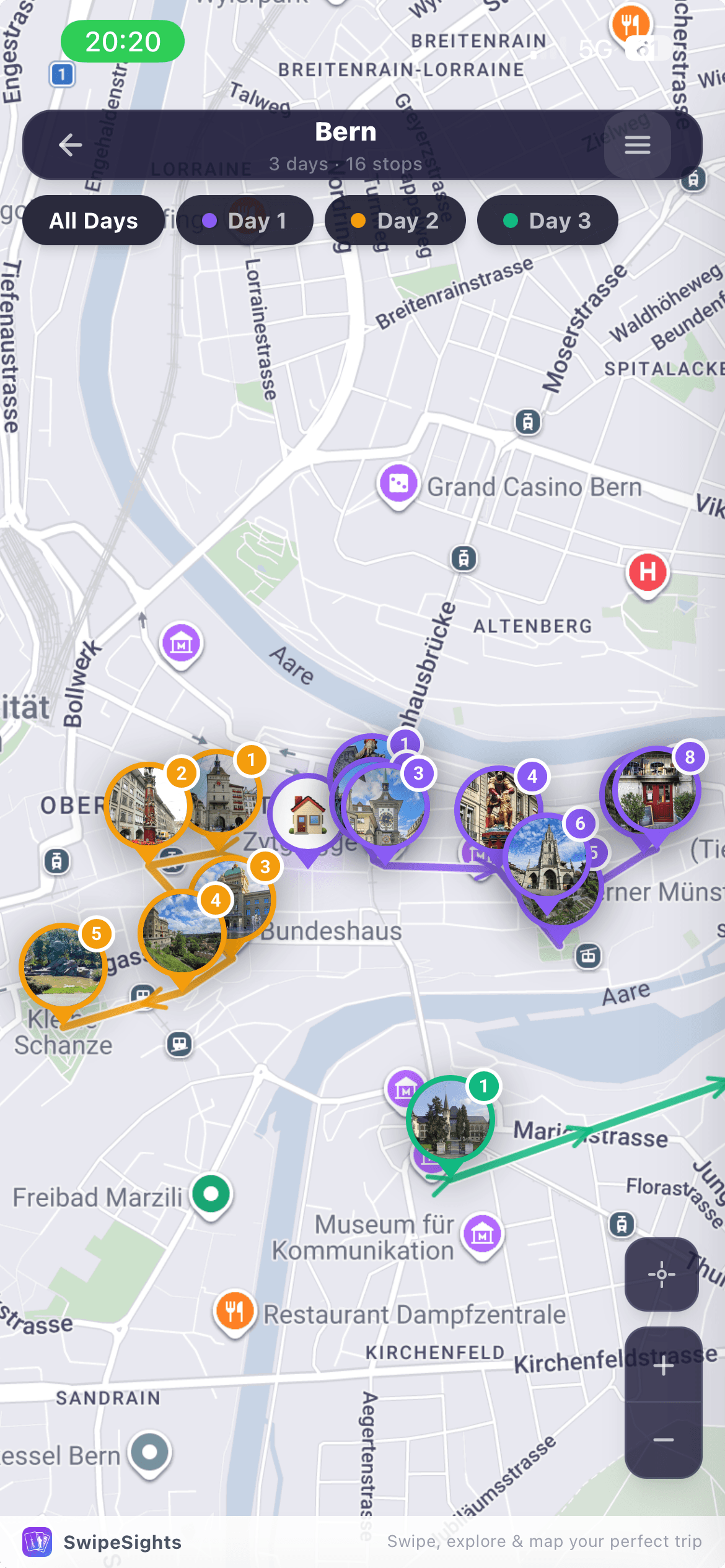
Your optimized walking route on an interactive map. Color-coded by day.
Frequently Asked Questions
Is solo travel safe?
Yes, especially in the cities most solo travelers visit. Use common sense, stay aware of your surroundings, and share your itinerary with someone at home. Millions of people travel solo every year without incident.
How do I avoid feeling lonely on a solo trip?
Stay in hostels with social spaces, join free walking tours, use apps like Meetup or Couchsurfing Hangouts, or simply sit at a bar and talk to people. Most solo travelers find that loneliness is rarely a problem because you are constantly meeting new people.
How much does a solo trip cost?
It depends on the destination. A budget solo trip in Europe can cost $50-80 per day including accommodation, food, and attractions. Mid-range is $100-200 per day. Southeast Asia can be as low as $30-50 per day.
What if I do not know what to do in a city?
That is exactly what SwipeSights solves. Create a trip, swipe through 60-100 real attractions with photos and ratings, and the app builds your day-by-day itinerary. Takes about 10 minutes.
Should I book everything in advance?
Book flights and accommodation in advance. For attractions, having a plan is better than winging it, but leave room for spontaneity. A tool like SwipeSights gives you the structure without locking you into a rigid schedule.
Is it weird to eat alone at a restaurant?
No. Nobody is watching you. Bring a book or your phone if it makes you feel more comfortable, but honestly, eating alone at a good restaurant in a new city is one of the underrated pleasures of solo travel.
What is the ideal length for a first solo trip?
Three to five days. Long enough to see a city properly and get comfortable being alone. Short enough that it does not feel overwhelming. You can always plan a longer trip once you know you enjoy it.
Can I use SwipeSights as a solo traveler?
Absolutely. SwipeSights works just as well for one person as it does for a group. You swipe on attractions, the app builds your itinerary. The only difference is you do not need to share a link or wait for anyone else to vote. The first 3 days of any itinerary are free.
Related reading
Traveling with friends next time? Here is the complete guide.
Short on time? Maximize every hour of a weekend getaway.
Skip the tourist traps. These cities are cheaper and less crowded.
Ready to Plan Your Solo Trip?
Unlimited free trips. The itinerary opens 3 days.
No credit card. No app download. Pick a city, swipe, and get your itinerary in minutes.
Start Planning for FreeSwipeSights turns 10 minutes of swiping into a fully optimized itinerary. Works for solo travelers and groups. Built by travelers who got tired of spreadsheets and overthinking.